Conveying Equipment for Agriculture & Animal Nutrition
Protect ingredient quality. Reduce material loss. Keep production moving.
Move feed ingredients, pellets, pet food and fertilizer products while protecting product quality and reducing material loss. UniTrak matches conveying and bulk bag handling equipment to your material, formulation and production layout, connecting receiving, blending and packaging around the handling requirements of your process.
Protect material quality throughout the production process.
PRODUCT BREAKAGE & DEGRADATION
Preserve the condition of pellets, granules and seeds.
Animal feed pellets, coated seeds and granulated fertilizers can be sensitive to impact and agitation.
Particle breakage may create unwanted fines, affect product consistency or damage protective coatings. In animal nutrition applications, preserving pellet integrity can also be important to maintaining the intended physical form of the finished feed.
Equipment selection should consider the complete transfer path, including feeding, elevation, changes in direction and discharge.
Gentle conveying and appropriately designed transitions can help reduce unnecessary degradation.
Feed meals, powdered supplements, grain products and fertilizer ingredients can generate dust during receiving, feeding and conveying.
Escaping material contributes to housekeeping requirements, ingredient loss and potential contamination of surrounding equipment.
Enclosed conveying can help limit material exposure, but effective containment also depends on equipment connections and transfer points.
Certain agricultural powders and dusts may present combustible-dust hazards. Equipment selection must account for the specific material and operating conditions.
Maintain the intended distribution of ingredients.
Animal feed formulations and blended fertilizers frequently contain materials with different particle sizes, shapes and bulk densities.
These differences can contribute to segregation during handling.
In fertilizer production, segregation can affect the distribution of nutrients within the finished blend. For feed manufacturers, inconsistent ingredient distribution may affect formulation consistency.
The conveying method, feeding arrangement and discharge conditions should be considered together to help limit unwanted separation.
Understand how ingredients behave under actual conditions.
Feed ingredients containing fats or oils can become sticky or prone to buildup.
Certain fertilizer materials absorb moisture, cake during storage or resist consistent discharge from hoppers. Cohesive powders may bridge above conveyor inlets or accumulate inside equipment.
Material temperature, moisture, particle characteristics and storage conditions can all influence performance.
Appropriate hopper geometry, controlled feeding and flow-assistance equipment may be required.
Different conveying methods address different agricultural handling requirements.
TIPTRAK® BUCKET ELEVATOR
Protect pellets and granules during elevation.
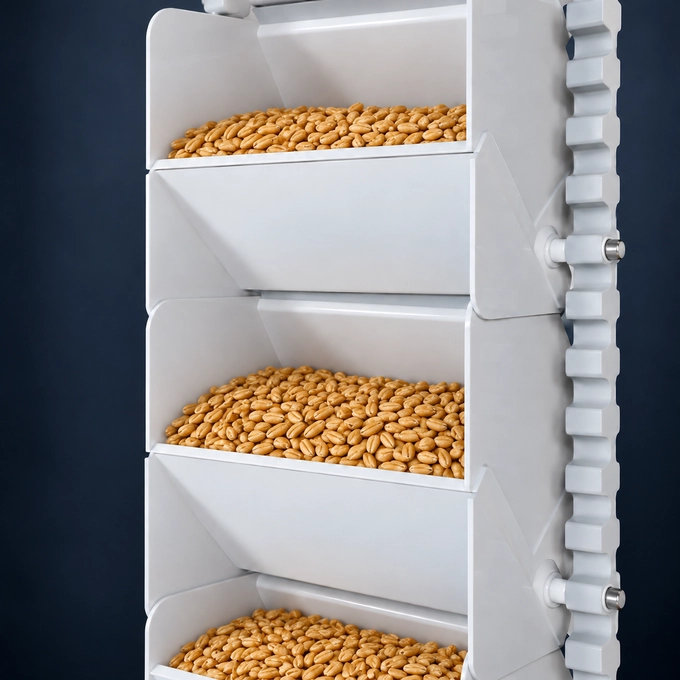
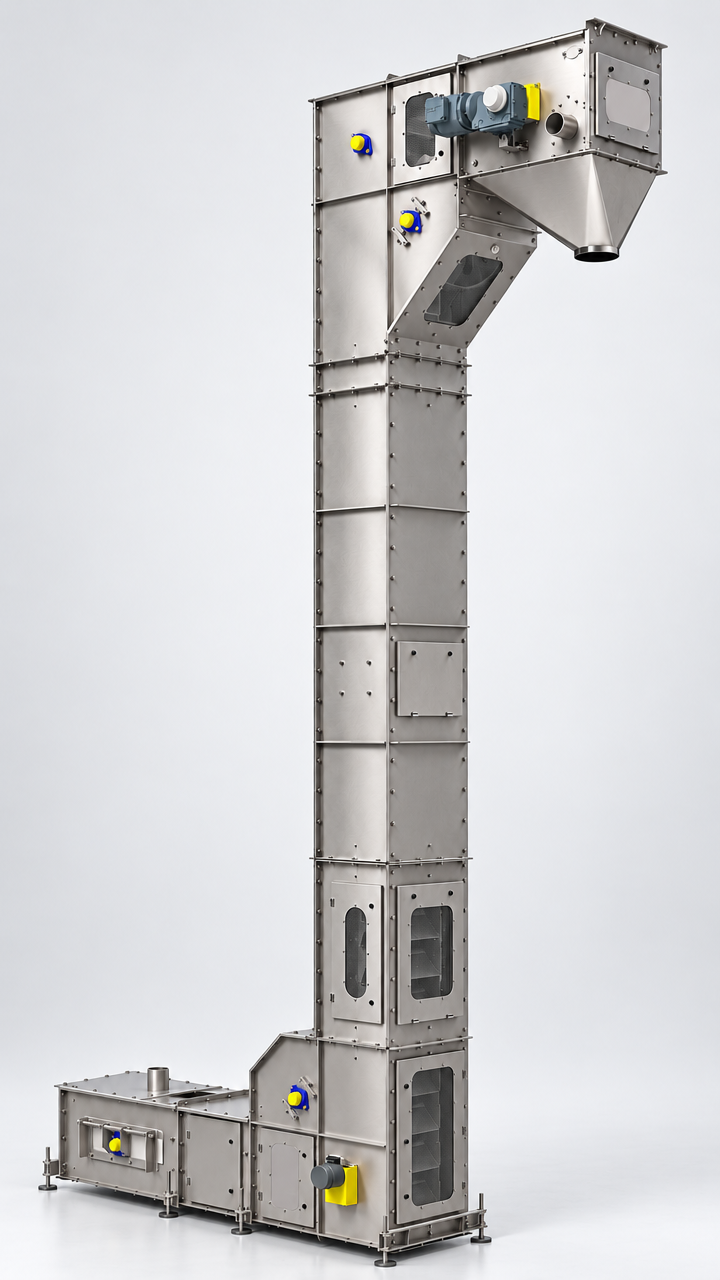
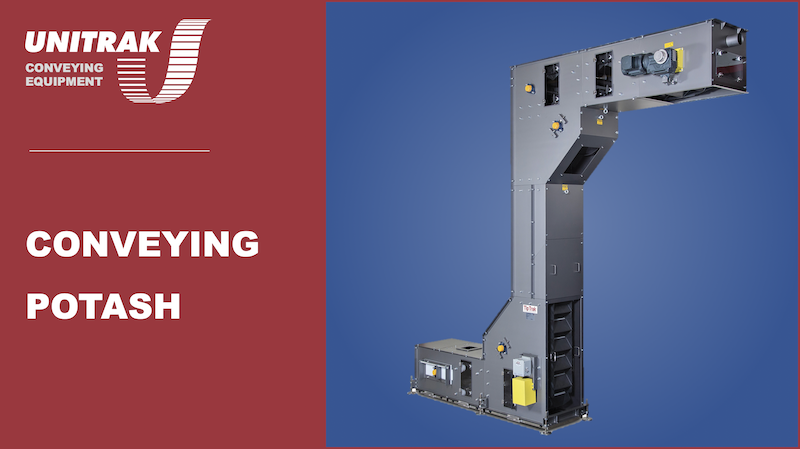
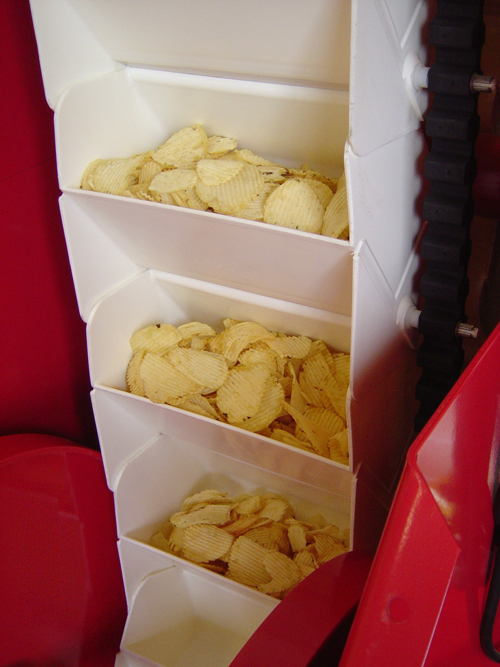
TipTrak’s low-speed, interlocking buckets convey feed pellets, pet food and fertilizer granules through horizontal and vertical sections while preventing spillage along the conveying path. Gentle handling protects fragile products, with construction and cleaning provisions selected around the material and process.
Consider for: Feed Pellets • Pet Food • Fertilizer Granules • Gentle Elevation • Controlled Transfer
Move ingredients with less dust and residual material.
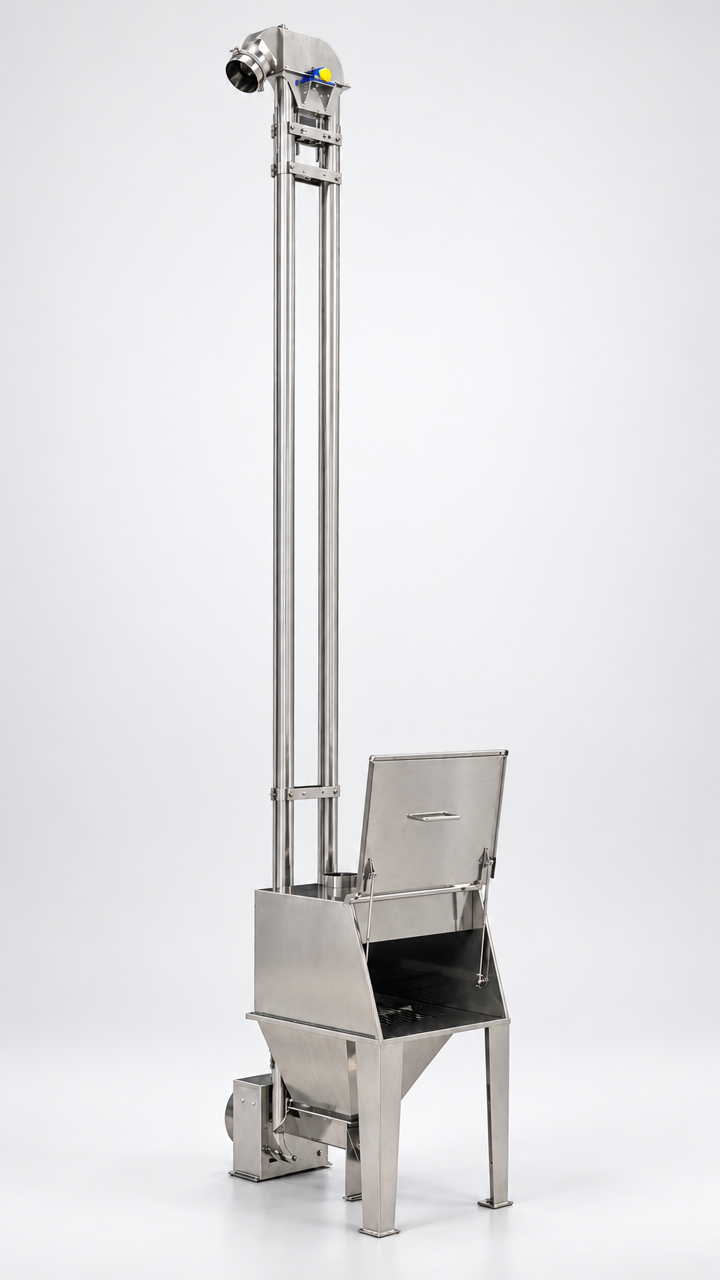
Powderflight’s rope-and-disc assembly generates an air stream that transfers dry bulk ingredients through an enclosed tube. Minimal product retention supports ingredient recovery and batch changeovers. At A-One Feed Supplements, Powderflight conveyors connected mixing with packaging and reduced dust, spillage and handling steps.
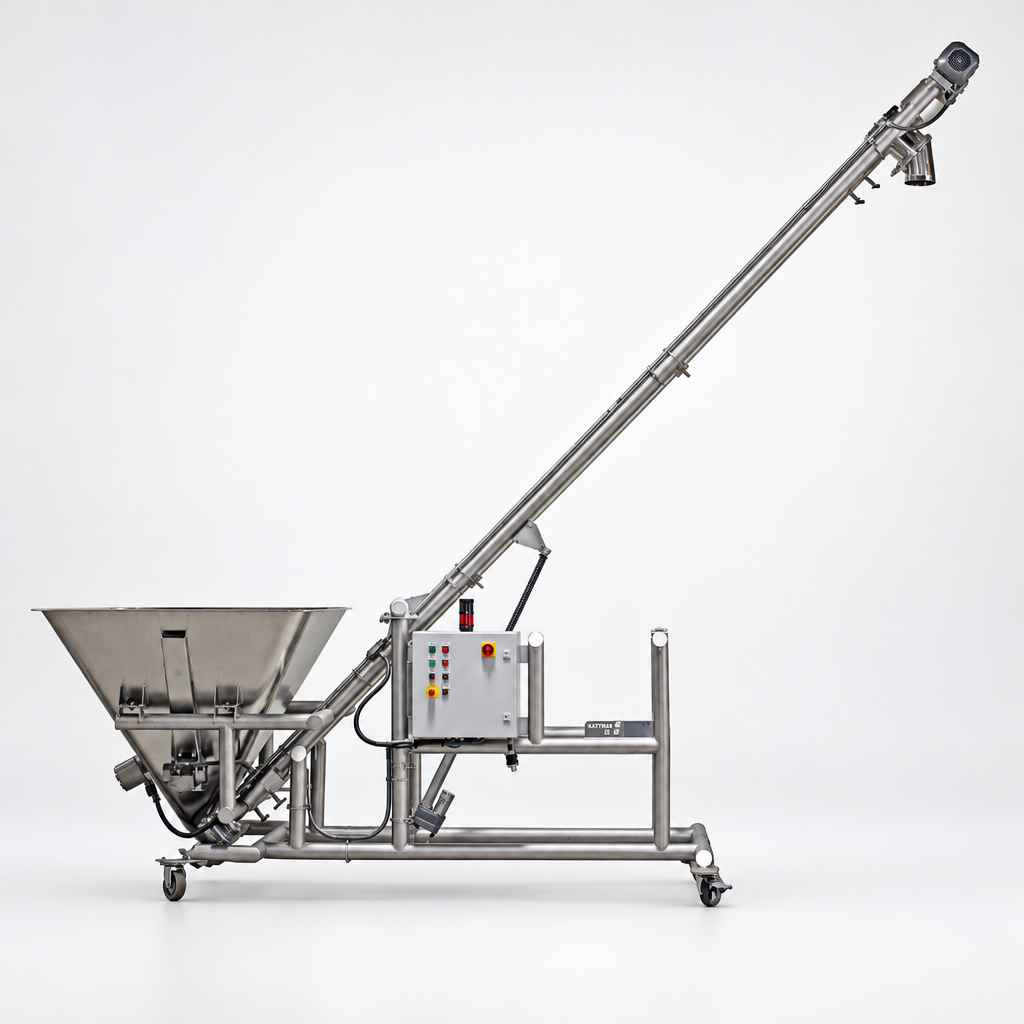
UniFlex moves compatible powders and granules from receiving hoppers to mixers and other process equipment. Its compact screw-and-tube arrangement suits batch transfer and installations with limited space. Material selection accounts for fragile pellets, abrasive minerals and difficult-flowing ingredients.
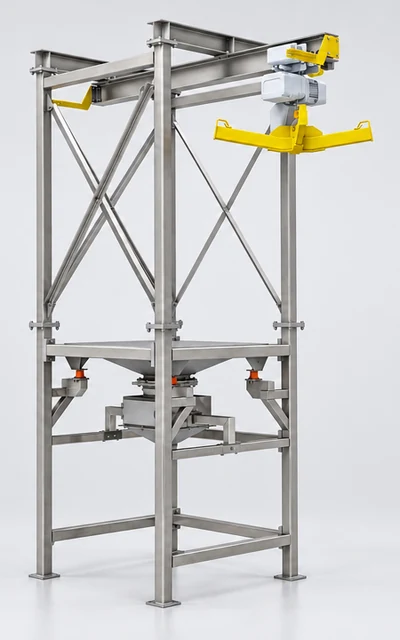
Bagstander unloaders and fillers connect bulk bags with hoppers, conveyors and weighing arrangements. Each system is built around the bag and application, with discharge, flow-assistance and batching components selected for the ingredients and production process.
Make product-contact areas easier to access and clean.
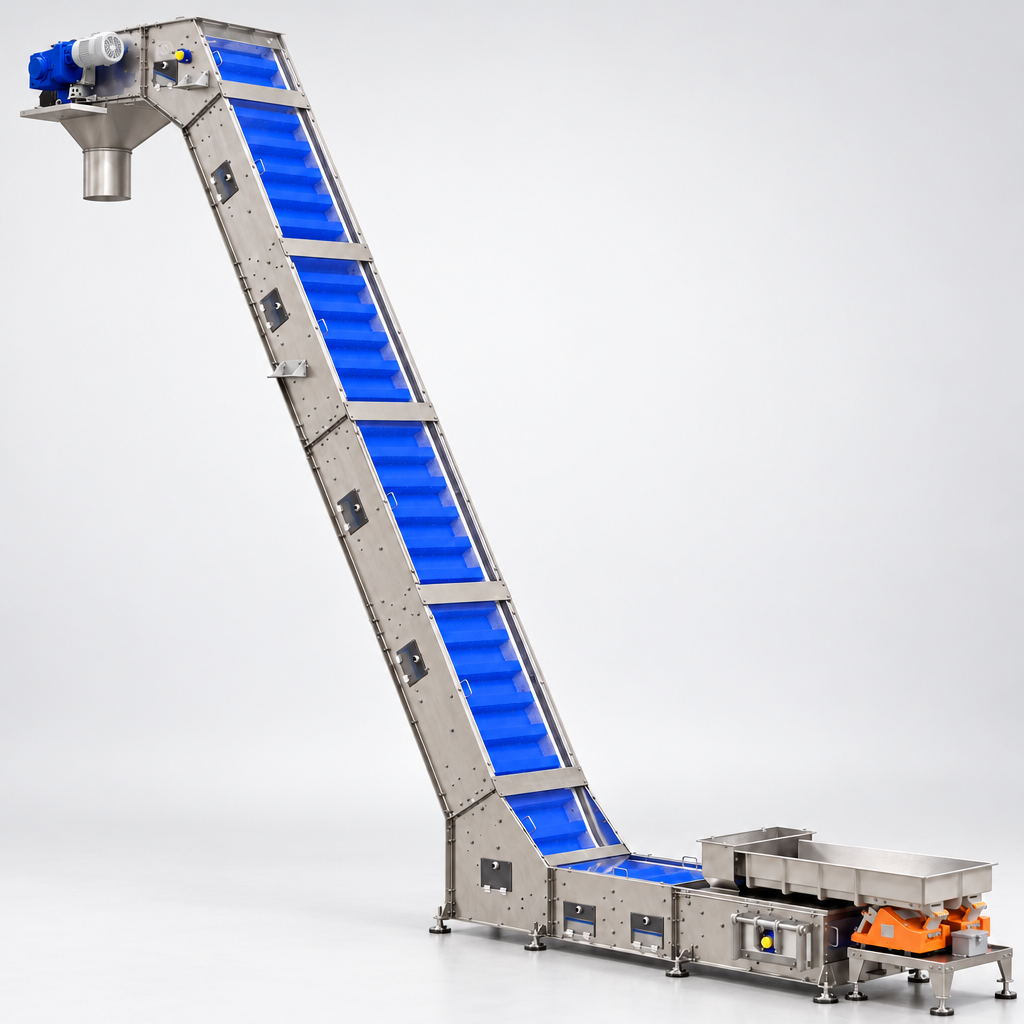
KleanTrak combines stainless steel construction with accessible belt and product-contact areas. It supports compatible pet food and animal nutrition applications where cleaning access, washdown or belt transfer are priorities. Belt material and cleaning arrangements are selected around the product.
Consider for: Pet Food • Cleaning Access • Washdown • Suitable Wet or Coated Products • Inclined Transfer
Reliable material transfer depends on the equipment around the conveyor.
Agricultural and animal nutrition production frequently involves several handling operations between raw material receiving and finished-product packaging.
Bulk bags may need to be unloaded, ingredients weighed, powders metered or products elevated into mixing and packaging equipment.
UniTrak can combine its conveying and bulk bag handling equipment with selected ancillary components to create a coordinated material-handling arrangement.
BULK BAG UNLOADING & FEED INGREDIENT TRANSFER
Bagstander → Receiving Arrangement → Powderflight → Downstream Process
Powderflight can receive material directly from a suitable hopper. Add metering or weighing equipment when the process requires controlled ingredient dosing or batching.
For applications requiring movement between several points in the production process.
UniTrak manufactures its core conveying and bulk bag handling equipment. Selected ancillary components may be sourced from specialist suppliers and incorporated into the agreed material-handling package.
Our scope is the agreed material-handling equipment and its integration with surrounding processes, rather than the design or supply of an entire agricultural production facility.
See how UniTrak equipment has supported animal nutrition and agricultural production.
A-One Feed Supplements — Connecting Mixing with Packaging
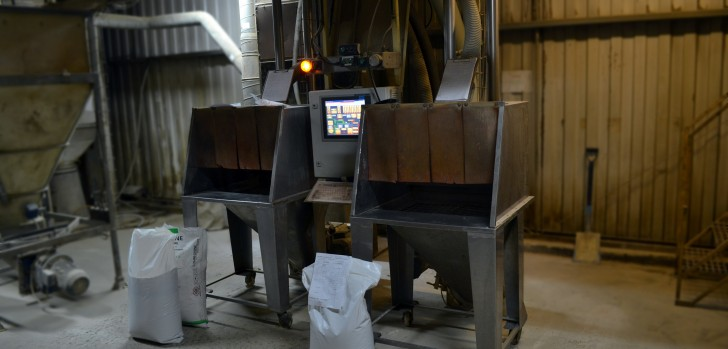
A-One Feed Supplements previously moved mixed feed products to bagging equipment in tote bins using forklifts. UniTrak supplied four M100 and two M75 Powderflight conveyors to connect mixing with packaging. The installation reduced dust and spillage, left minimal residue and saved handling and packaging time, helping increase factory output.
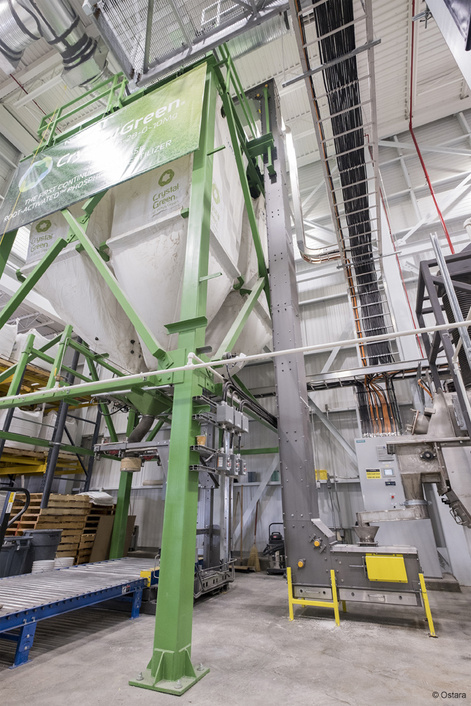
Ostara needed to move valuable fertilizer granules within a compact installation while protecting product integrity and controlling spillage. UniTrak supplied TipTrak bucket elevators for the nutrient-recovery process. The published case study describes adoption across multiple installations and Ostara’s standardization on the equipment at its North American and European sites.
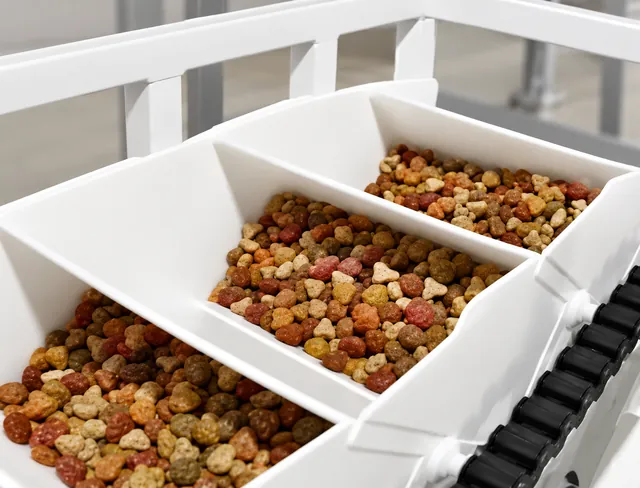
An international pet food producer needed to transfer warm, friable product from an extruder while reducing spillage and breakage. UniTrak supplied an S5 TipTrak with interlocking buckets and its rubber BeltChain. The installation reduced product spillage, cleanup and disposal costs, while gentler handling reduced breakage and improved throughput yield.
Test your actual feed ingredient, pellet, pet food or fertilizer product to understand feeding, conveying and discharge behaviour. UniTrak can assess breakage, fines, sticking, product retention and blend behaviour under the test conditions, helping refine equipment selection and the transfer arrangement.
Depending on the application, testing can examine:
Pellet and granule breakage
Generation of fines
Feeding and discharge consistency
Sticking, caking or material buildup
Product retention
Segregation of blended materials
Conveying performance under the test conditions
Suitability of the proposed conveying arrangement
Contact our team with the material details and SDS before sending samples so we can confirm the test requirements.
TipTrak provides gentle elevation for fragile feed pellets and pet food. Powderflight provides enclosed transfer for compatible powdered ingredients and supplements, while UniFlex provides compact ingredient transfer. Selection depends on the formulation, required throughput, cleaning requirements and process layout.
Yes. TipTrak’s low-speed, interlocking buckets protect fragile feed pellets during horizontal and vertical conveying. The feeding and discharge arrangements are developed around the product, and material testing can assess breakage and fines through the proposed transfer.
UniTrak can evaluate suitable powdered and granular feed premixes.
Equipment selection should consider dust generation, ingredient retention, flow characteristics and the potential for segregation.
The appropriate conveying method depends on the actual formulation and process requirements.
Yes. TipTrak conveys pet food where gentle handling, elevation and spillage prevention are priorities. Applications can include product after extrusion as well as finished kibble, with temperature, moisture, coatings and cleaning requirements considered during selection. KleanTrak provides an alternative where accessible belt conveying is the better fit.
Enclosed conveying equipment can help limit the release of material during transfer.
Effective dust control also depends on the inlet, discharge, equipment connections and associated dust-management provisions.
Combustible-dust applications require an application-specific engineering and safety review.
Certain conveying methods may help limit segregation of suitable blended materials.
However, segregation depends on the ingredient mixture, particle characteristics and complete transfer arrangement.
Material testing can help evaluate how a specific formulation behaves during conveying.
UniTrak can evaluate applications involving coated seeds and other fragile agricultural products.
Gentle handling may help reduce coating damage and particle degradation.
Equipment selection depends on seed characteristics, coating properties and the required conveying arrangement.
Yes. UniTrak has experience with fertilizer-handling applications.
TipTrak can be considered for suitable granulated products where gentle handling and controlled elevation are priorities.
Powderflight may be considered for compatible powdered fertilizer ingredients.
Chemical compatibility, corrosion, dust hazards and material flow must be reviewed.
UniTrak can evaluate applications involving mineral supplements and other abrasive materials.
Particle hardness, bulk density, conveying speed and equipment construction influence suitability and expected wear.
Material testing may help assess conveying behavior, but short tests cannot necessarily predict long-term component wear.
Yes. Bagstander bulk bag handling equipment can be combined with receiving hoppers, valves, feeders and conveyors.
Selected arrangements can also incorporate weighing equipment and batching controls.
Cleaning provisions vary by equipment and configuration.
KleanTrak provides accessible product-contact areas, while other equipment offers application-specific cleaning and cleanout arrangements.
The proposed equipment and cleaning procedure should be evaluated against the plant's contamination-control requirements.
Applications involving medicated feed require particular attention to product retention, cleaning and prevention of unintended carryover.
UniTrak can review these requirements when evaluating suitable conveying equipment.
The customer must establish and validate cleaning procedures and compliance with applicable feed-manufacturing requirements.
Yes. UniTrak can develop conveying arrangements that interface with compatible mixers, blenders, storage equipment and packaging machinery.
Inlet and discharge connections, feed rates and controls should be reviewed with the customer or equipment supplier.
UniTrak's scope is the agreed material-handling equipment rather than the complete feed-processing system.
Yes. UniTrak offers material testing for suitable applications.
Testing can help evaluate product breakage, feeding, discharge, retention and other handling characteristics.
Testing is subject to material safety review and the capabilities of the available equipment.
Start with the material and the handling problem you need to solve.
Tell us what you're conveying, where it needs to go and what happens during the existing transfer process.
Our team can review your material characteristics, required throughput, equipment layout and operating conditions to help determine an appropriate conveying arrangement.
For agriculture and animal nutrition applications, useful information includes:
Material name and physical form
Particle size and bulk density
Required conveying rate
Transfer distance and elevation
Moisture and temperature conditions
Dust containment requirements
Product breakage or coating-damage concerns
Segregation or formulation consistency concerns
Abrasion, corrosion or sticking concerns
Cleaning and product changeover requirements
Existing processing equipment and connections
Whether you're developing a new feed production process or replacing equipment that damages pellets, creates dust or struggles with difficult materials, UniTrak can help evaluate the next step.